Quality as a technology of governmentality
performativity and subjectivation in academic work
DOI:
https://doi.org/10.58980/eiaerh.v12iesp1.455Keywords:
Quality, Governmentality, Teacher training, Performativity, SubjectivationAbstract
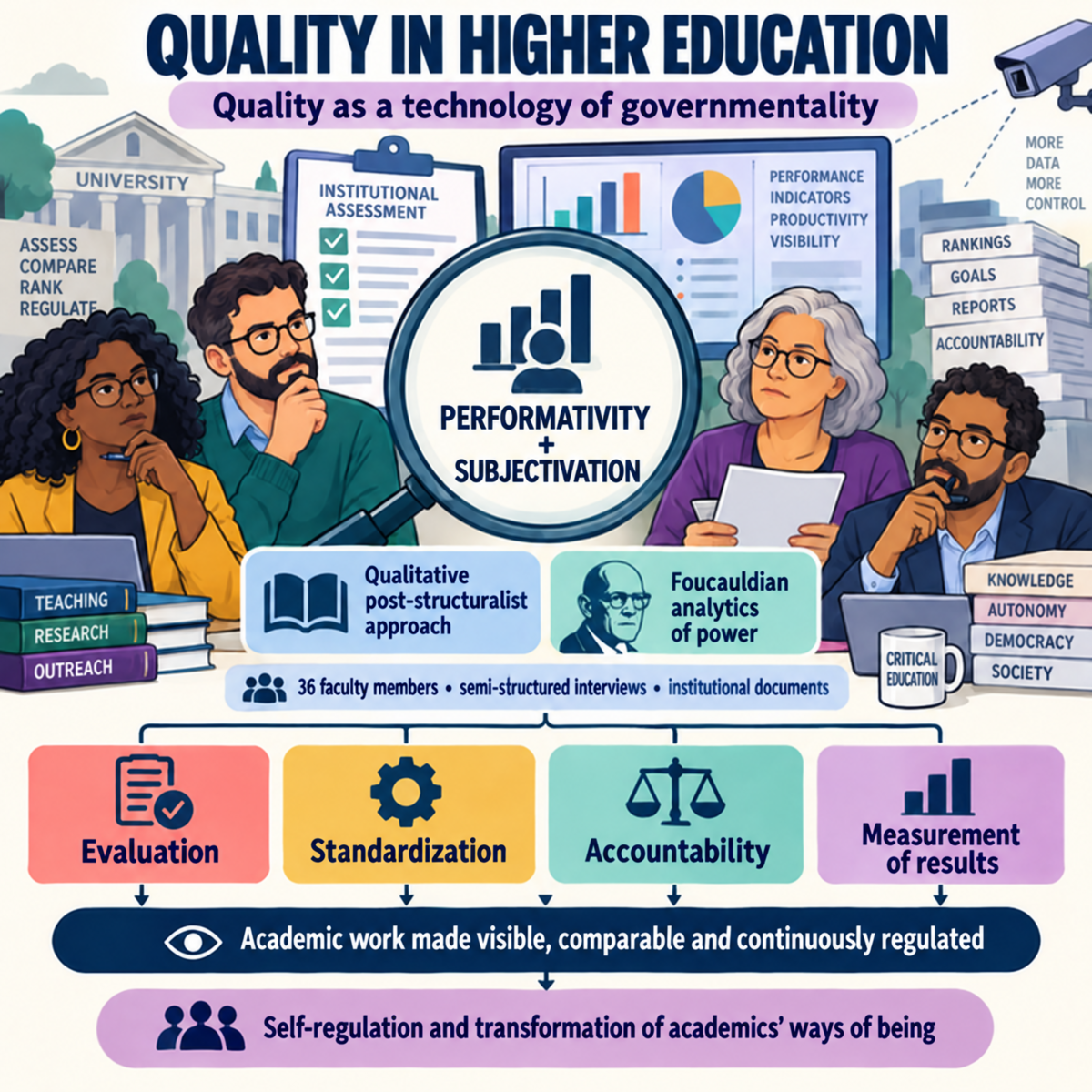
Quality in higher education represents a central element in educational policies, associated with faculty qualifications and the enhancement of teaching and learning processes. This study analyzes quality as a technology of governmentality, investigating its effects on academic work in terms of performativity and subjectivation. It adopts a qualitative poststructuralist approach grounded in a Foucauldian analytics of power. The research, conducted at a higher education institution, drew on semi-structured interviews with 36 faculty members and an analysis of institutional documents. The results reveal that quality materializes through mechanisms of evaluation, standardization, accountability, and outcome measurement, making faculty work visible, comparable, and subject to continuous regulation. These devices intensify performativity and encourage self-regulation. The study concludes that quality functions as a technology of government, significantly influencing the formation and ways of being of academics.
Downloads
References
BALL, Stephen J. The teacher’s soul and the terrors of performativity. Journal of Education Policy, [s. l.], v. 18, n. 2, p. 215–228, 2003. DOI: 10.1080/0268093022000043065. Disponível em: https://www.tandfonline.com/doi/epdf/10.1080/0268093022000043065?needAccess=true. Acesso em: 30 out. 2026. DOI: https://doi.org/10.1080/0268093022000043065
DEAN, Mitchell. Governmentality: power and rule in modern society. 2. ed. London: SAGE Publications, 2010.
FOUCAULT, Michel. Nascimento da biopolítica: curso no Collège de France (1978–1979). São Paulo: Martins Fontes, 2008.
FOUCAULT, Michel. Vigiar e punir: nascimento da prisão. Petrópolis, RJ: Vozes, 2014.
HUBER, Claudia Maria. O discurso da qualidade e o trabalho dos académicos no ensino superior: um estudo de caso na UNIJUÍ. 2018. Tese (Doutorado em Gestão) – Faculdade de Economia, Universidade do Porto, Porto, Portugal, 2019. Disponível em: https://sigarra.up.pt/fep/pt/teses.tese?p_aluno_id=99742&p_lang=0&p_processo=17725. Acesso em: 23 out. 2026.
MARQUES, Raquel M. G.; LOPES, Amélia; MAGALHÃES, António M. Academic identities and higher education change: reviewing the evidence. Educational Research, [s. l.], v. 66, n. 2, p. 228–244, 2024. DOI: 10.1080/00131881.2024.2334760. Disponível em: https://www.tandfonline.com/doi/full/10.1080/00131881.2024.2334760. Acesso em: 30 oct. 2026. DOI: https://doi.org/10.1080/00131881.2024.2334760
OLSSEN, Mark; PETERS, Michael A. Neoliberalism, higher education and the knowledge economy: from the free market to knowledge capitalism. Journal of Education Policy, [s. l.], v. 20, n. 3, p. 313–345, 2005. DOI: 10.1080/02680930500108718. Disponível em: https://www.tandfonline.com/doi/abs/10.1080/02680930500108718. Acesso em: 30 out. 2026. DOI: https://doi.org/10.1080/02680930500108718
ROMANOWSKI, Joana P. Controlling higher education from a distance: using Foucault’s governmentality to better understand accreditation. Journal of Education Policy, [s. l.], v. 28, n. 5, p. 648–662, 2013. DOI: 10.1080/2331186X.2022.2073631. Disponível em: https://www.tandfonline.com/doi/full/10.1080/2331186X.2022.2073631. Acesso em: 30 out. 2026.
ROSE, Nikolas. Powers of freedom: reframing political thought. Cambridge: Cambridge University Press, 1999. DOI: https://doi.org/10.1017/CBO9780511488856
SHORE, Cris; ROBERTS, Stephen. Higher education and the panopticon paradigm: quality assurance as surveillance. Education Policy Analysis Archives, [s. l.], v. 3, n. 7, 1995. Disponível em: https://scispace.com/pdf/higher-education-and-the-panopticon-paradigm-quality-105ape9fmm.pdf. Acesso em: 30 out. 2026.
SKEA, Chris. Emerging neoliberal academic identities: a review of the literature. Higher Education Research & Development, [s. l.], v. 40, n. 6, p. 1230–1244, 2021. DOI: 10.1080/07294360.2020.1792850. Disponível em: https://www.tandfonline.com/doi/full/10.1080/07294360.2020.1792850. Acesso em: 30 out. 2026.
SKEA, Chris. Emerging neoliberal academic identities: looking beyond Homo Economicus. Studies in Philosophy and Education, [s. l.], v. 40, n. 4, p. 399–414, 2021. DOI: 10.1007/s11217-021-09768-7. Disponível em: https://link.springer.com/article/10.1007/s11217-021-09768-7. Acesso em: 30 out. 2026. DOI: https://doi.org/10.1007/s11217-021-09768-7
VISSER, Mart; STOKES, Peter; ASHTA, Arvind; ANDERSSON, Lars M. The ‘performative’ university: theoretical and personal reflections. Journal of Education Policy, [s. l.], v. 39, n. 6, p. 1030–1048, 2024. DOI: 10.1080/02680939.2024.2403431. Disponível em: https://www.tandfonline.com/doi/full/10.1080/02680939.2024.2403431. Acesso em: 30 out. 2026. DOI: https://doi.org/10.1080/02680939.2024.2403431
Downloads
Published
Issue
Section
License
Copyright (c) 2026 Revista Hipótese

This work is licensed under a Creative Commons Attribution 4.0 International License.