The relevance of technology in the context of emergency remote teaching
DOI:
https://doi.org/10.58980/eiaerh.v12i00.438Keywords:
Education, Emergency remote teaching, Social isolation, Technology, Covid-19Abstract
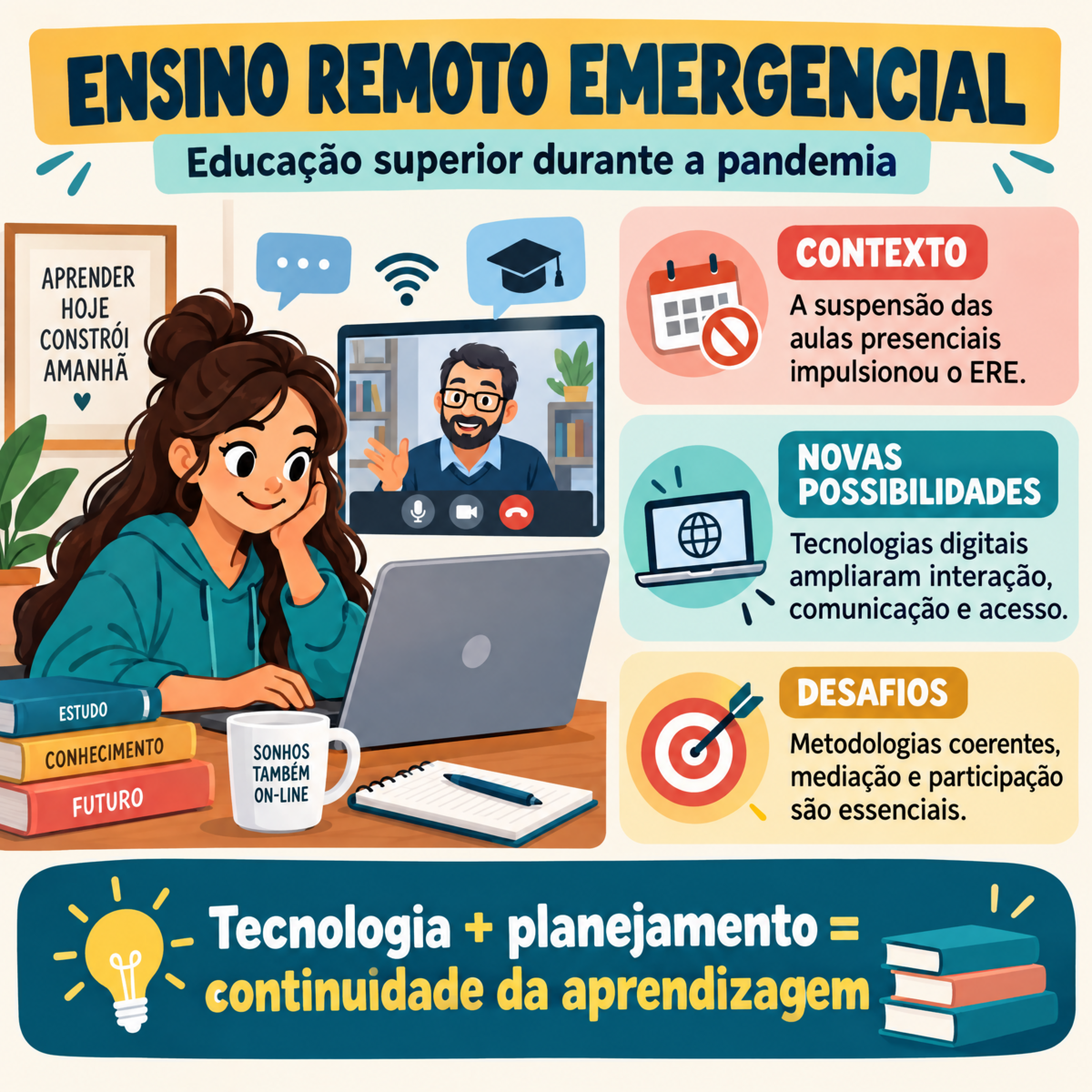
This article reflects upon the possibilities of remote teaching in the context of Emergency Remote Teaching (ERT), a response to the suspension of in-person activities during the COVID-19 pandemic. Against this backdrop, the article examines resources, strategies, and pedagogical possibilities mediated by digital technologies experimented with by higher education institutions (HEIs) to ensure the continuity of academic activities. The reorganization of educational practices has driven the incorporation and reappraisal of digital technologies and environments, expanding possibilities for interaction, communication, access, and student monitoring. In this context, remote teaching highlighted not only the availability of technology but also the need to articulate it with methodological approaches consistent with educational objectives and students’ concrete conditions. It is concluded that emergency remote teaching has enhanced possibilities already present in the educational landscape while simultaneously revealing challenges regarding interaction, pedagogical mediation, and the participation of those involved in the educational process.
Downloads
References
CIPRIANI, Flávia Marcele; MOREIRA, Antônio Flávio Barbosa; CARIUS, Ana Carolina. Atuação docente na educação básica em tempo de pandemia. Educação & Realidade, [s. l.], v. 46, n. 2, e105199, 2021. DOI: https://doi.org/10.1590/2175-6236105199. Disponível em: https://www.scielo.br/j/edreal/a/tqLcF8PZfsBxsyF3ZKpyM9N/?lang=pt. Acesso em: 21 out. 2026.
CRUZ, Carla; RIBEIRO, Uirá. Metodologia científica: teoria e prática. Rio de Janeiro: Axcel Books, 2009.
DOWBOR, Ladislau. A reprodução social. São Paulo: Vozes, 1998. Disponível em: https://dowbor.org/wp-content/uploads/2020/08/01repsoc1.pdf. Acesso em: 21 out. 2026.
FRANÇA, George. Os ambientes de aprendizagem na época da hipermídia e da educação a distância. Perspectivas em Ciência da Informação, [s. l.], v. 14, n. 1, 2009. DOI: https://doi.org/10.1590/S1413-99362009000100005. Disponível em: https://www.scielo.br/j/pci/a/yMW89xpFj9y84q5HRHrxHxB/?lang=pt. Acesso em: 21 out. 2026.
MARCUSCHI, Luiz Antônio. Produção textual, análise de gêneros e compreensão. São Paulo: Parábola Editorial, 2008. Disponível em: https://dlm.fflch.usp.br/sites/dlm.fflch.usp.br/files/MARCUSCHI-Luiz-Antonio__O-processo-de-producao-textual.pdf. Acesso em: 21 out. 2026.
O QUE é tecnologia? Portal da Educação, [s. d.]. Disponível em: https://blog.portaleducacao.com.br/o-que-e-tecnologia/ Acesso em: 21 out. 2026.
ROCHA, Jorge Vieira da; SANTOS, Sonia Regina Mendes dos. A importância da tecnologia durante o ensino remoto emergencial. Áquila, [s. l.], n. 31, p. 167–182, 2025. DOI: 10.61565/2317-6474.2024.571. Disponível em: https://ojs.uva.br/index.php/revista-aquila/article/view/203. Acesso em: 21 out. 2026.
SCHERER, Suely. Educação bimodal: habitantes, visitantes ou transeuntes? In: VALENTE, José Armando; BUSTAMANTE, Silvia Branco Vidal (org.). Educação a distância: prática e formação do profissional reflexivo. São Paulo: Avercampo, 2009.
SILVA, Tania Tavares; COELHO, Suzanete Zahed. O papel da reflexão e dos mediadores na capacitação de aprendizes-colaboradores: um dos suportes andragógicos das comunidades virtuais de aprendizagem. In: VALENTE, José Armando; BUSTAMANTE, Silvia Branco Vidal (org.). Educação a distância: prática e formação do profissional reflexivo. São Paulo: Avercampo, 2009. p. 205-260.
SPANHOL, Greicy Kelli; SPANHOL, Fernando José. Processos de produção de videoaula. Novas Tecnologias na Educação, v. 7, n. 1, p. 1-9, 2009. Disponível em: https://seer.ufrgs.br/index.php/renote/article/download/13903/7812/47538. Acesso em: 21 out. 2026.
VALENTINI, Carla Beatris; SOARES, Eliana Maria do Sacramento (org.). Aprendizagem em ambientes virtuais: compartilhando ideias e construindo cenários. 2 ed. Caxias do Sul: Educs, 2010. E-book (335 p.). ISBN 978-85-7061-600-5 Disponível em: https://www.ucs.br/educs/livro/aprendizagem-em-ambientes-virtuais-compartilhando-ideias-e-construindo-cenarios/. Acesso em: 21 out. 2026.
Downloads
Published
Issue
Section
License
Copyright (c) 2026 Revista Hipótese

This work is licensed under a Creative Commons Attribution 4.0 International License.