Digital learning and the will to learn
a critical dialogue between tradition and conteporary pedagogy
DOI:
https://doi.org/10.58980/eiaerh.v12i00.451Keywords:
Education of the will, Digital Information and Communication Technologies, LearningAbstract
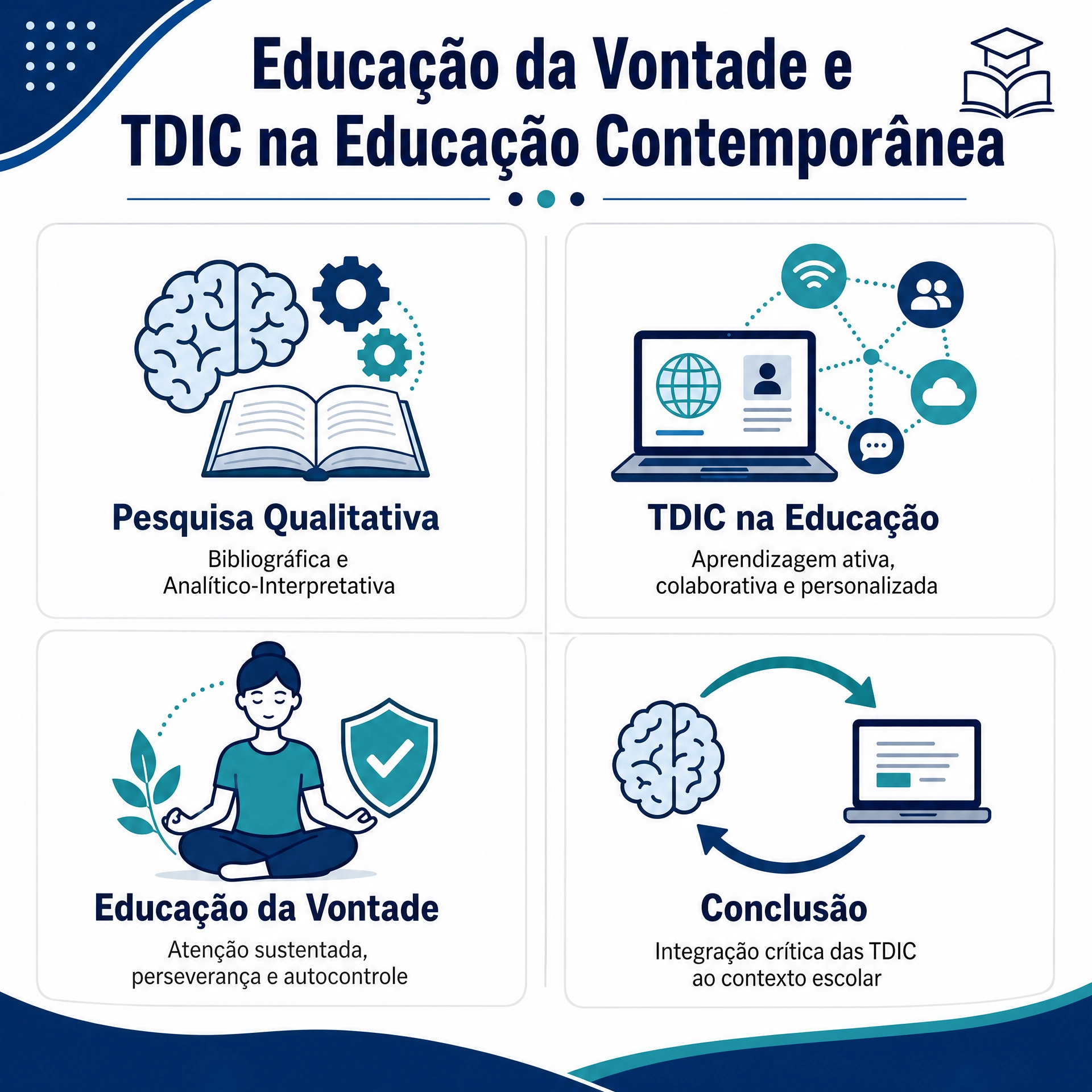
This study critically examines the relationships between the education of the will, contemporary pedagogical approaches, and the growing incorporation of Information and Communication Technologies (ICT) into educational processes. It is a qualitative, bibliographic, and analytical-interpretative study grounded in references from philosophy of education, cognitive psychology, neuroscience, and educational technology literature. The analysis shows that, although contemporary authors attribute to ICT the potential to foster active, collaborative, and personalized learning, the development of dispositions such as sustained attention, perseverance, and self-control receives less emphasis in this debate. The study concludes that linking the tradition of education of the will with discussions on digital technologies may broaden the understanding of the cognitive and anthropological conditions required for learning and contribute to a more critical integration of ICT in school contexts.
Downloads
References
ARENDT, Hannah. Entre o passado e o futuro. Tradução de Mauro W. Barbosa. 8. ed. São Paulo: Perspectiva, 2016.
ARISTÓTELES. Ética a Nicômaco. Tradução de Luciano Ferreira de Souza. São Paulo: Martin Claret, 2015.
BRASIL. Relatório Brasil no PISA 2018. Brasília: INEP, 2020.
CRATO, Nuno. O “eduquês” em discurso direto: uma crítica da pedagogia romântica e construtivista. Campinas: Kírion, 2020.
DESMURGET, Michel. A fábrica de cretinos digitais: os perigos das telas para nossas crianças. Tradução de Mauro Pinheiro. São Paulo: Vestígio, 2021.
ENKVIST, Inger. Repensar a educação. Tradução de Daniela Trindade. São Paulo: Bunker Editorial, 2014.
ENKVIST, Inger. A boa e a má educação. Campinas: Kírion, 2020.
FAJARDO, Vanessa. Como o analfabetismo funcional influencia a relação com as redes sociais no Brasil. BBC News Brasil, São Paulo, 12 nov. 2018. Disponível em: https://www.bbc.com/portuguese/brasil-46177957. Acesso em: 3 jul. 2026.
HARARI, Yuval Noah. 21 lições para o século XXI. Tradução de Paulo Geiger. São Paulo: Companhia das Letras, 2018.
KRAUSHAAR, James M.; NOVAK, David C. Examining the Effects of Student Multitasking with Laptops during the Lecture. Journal of Information Systems Education, [S. l.], v. 21, n. 2, p. 241-251, 2010. Disponível em: https://jise.org/Volume21/n2/JISEv21n2p241.pdf. Acesso em: 15 jul. 2026.
L’ECUYER, Catherine. Educar na realidade. São Paulo: Fons Sapientiae, 2018.
LEMBKE, Anna. Nação dopamina. Tradução de Elisa Nazarian. São Paulo: Vestígio, 2022.
LEWIS, C. S. A abolição do homem. Tradução de Gabriele Greggersen. Rio de Janeiro: Thomas Nelson Brasil, 2017.
LIMA, Ana; CATELLI JR., Roberto. INAF Brasil 2018: resultados preliminares. São Paulo: Ação Educativa, 2018.
MACINTYRE, Alasdair. Depois da virtude: um estudo sobre a teoria moral. Tradução de Pedro Arruda e Pablo Costa. Campinas: Vide Editorial, 2021.
MORAN, Jorge. Metodologias ativas para uma aprendizagem mais profunda. In: BACICH, Lilian; MORAN, Jorge (org.). Metodologias ativas para uma educação inovadora: uma abordagem teórico-prática. Porto Alegre: Penso, 2018. p. 35-76.
MORTON, J. Bruce. Funções executivas. Enciclopédia sobre o Desenvolvimento na Primeira Infância, Montreal, 2013. Disponível em: https://www.enciclopedia-crianca.com/funcoes-executivas. Acesso em: 3 jul. 2026.
PAPERT, Seymour; HAREL, Idit. Situating Constructionism. In: PAPERT, Seymour; HAREL, Idit (ed.). Constructionism: Research Reports and Essays, 1985-1990. Norwood: Ablex, 1991. p. 1-11.
PAYOT, Jules. A educação da vontade. Tradução de Roberto Mallet. Campinas: Kírion, 2018.
PLATÃO. A República. Tradução de Maria Helena da Rocha Pereira. 16. ed. Lisboa: Fundação Calouste Gulbenkian, 2021.
PRENSKY, Marc. Digital Natives, Digital Immigrants. On the Horizon, [S. l.], v. 9, n. 5, p. 1-6, 2001. DOI: 10.1108/10748120110424816. DOI: https://doi.org/10.1108/10748120110424816
SAYERS, Dorothy. As ferramentas perdidas da aprendizagem. Tradução de Cipriana Leme. São Paulo: Old School, 2009.
SIEMENS, George. Connectivism: A Learning Theory for the Digital Age. E-LearnSpace, Winnipeg, 2004. Disponível em: https://static1.squarespace.com/static/6820668911e3e5617c36c48c/t/682dadc9690ec5749004d96d/1747824073835/connectivism.pdf. 15 jul. 2026.
TURLEY, Stephen. Educação clássica vs. educação moderna: a visão de C. S. Lewis. Tradução de Elmer Pires. São Paulo: Trinitas, 2018.
TURLEY, Stephen. Teologia do deslumbramento. Tradução de Elmer Pires. São Paulo: Trinitas, 2019.
WEAVER, Richard M. As ideias têm consequências. Tradução de Guilherme Araújo Ferreira. São Paulo: É Realizações, 2016.
Downloads
Published
Issue
Section
License
Copyright (c) 2026 Revista Hipótese

This work is licensed under a Creative Commons Attribution 4.0 International License.