Who cares for those who educate? Teaching, dignity, and illness in early childhood education
DOI:
https://doi.org/10.58980/eiaerh.v12iesp1.454Keywords:
Teaching, Early Childhood Education, Dignity, Occupational health, Collective workAbstract
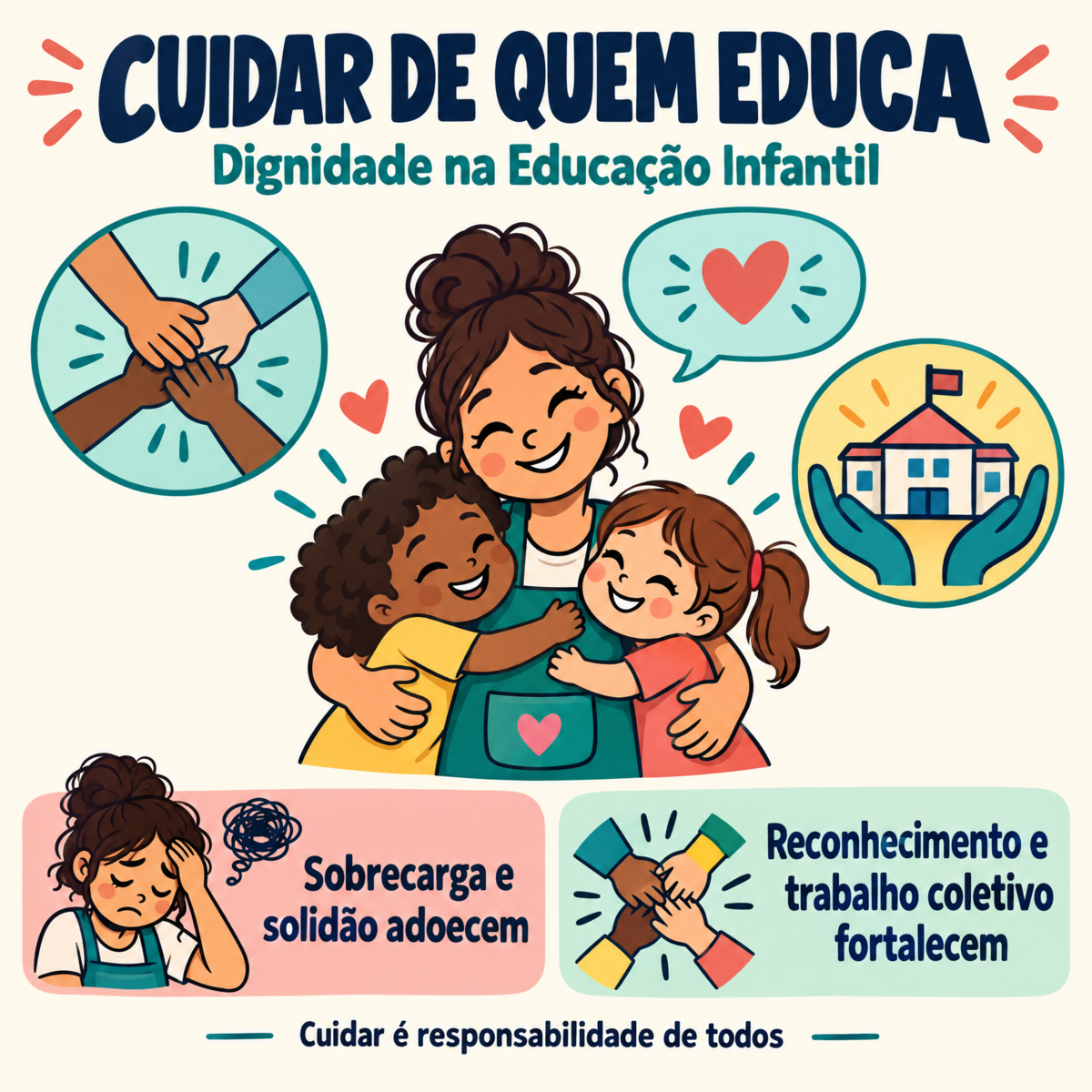
Teaching in Early Childhood Education combines care, pedagogical intentionality, and public responsibility, yet it is often performed under conditions that weaken teachers’ recognition and health. This article examines how the production of dignity through work is affected by overload, professional loneliness, and the individualization of suffering. It offers a new interpretive reading of qualitative research conducted with fifteen teachers from a public Early Childhood Education center in a municipality of Santa Catarina, Brazil. Data were produced through semi-structured interviews, focus groups, and a field diary, and examined using thematic content analysis. Findings show that care becomes dehumanizing when it is confused with unlimited availability and sustained by silent sacrifice. Teacher dignity emerges from relationships of recognition, participation, and shared responsibility. Caring for those who educate therefore requires institutional conditions, collective work, and public policies that do not turn illness into an individual problem.
Downloads
References
ALEXANDRINO, Tarsilla Noemi Bertoli; ZLUHAN, Mara Regina; CORRÊA, Shirlei de Souza. Sentidos ambivalentes atribuídos pelos professores ao trabalho docente. Revista on line de Política e Gestão Educacional, Araraquara, v. 29, n. 00, e025012, 2025. DOI: 10.22633/rpge.v29i00.20286. Disponível em: https://periodicos.fclar.unesp.br/rpge/article/view/20286 . Acesso em: 28 jul. 2026. DOI: https://doi.org/10.22633/rpge.v29i00.20286
BERLINGUER, Giovanni. Bioética cotidiana. Brasília: Universidade de Brasília, 2015.
BRASIL. Conselho Nacional de Saúde. Resolução nº 466, de 12 de dezembro de 2012. Aprova diretrizes e normas regulamentadoras de pesquisas envolvendo seres humanos. Brasília, DF: Conselho Nacional de Saúde, 2012.
BRASIL. Constituição da República Federativa do Brasil de 1988. Brasília, DF: Senado Federal, 1988.
BRASIL. Lei nº 9.394, de 20 de dezembro de 1996. Estabelece as diretrizes e bases da educação nacional. Brasília, DF: Presidência da República, 1996.
BRESSER-PEREIRA, Luiz Carlos. Capitalismo financeiro-rentista. Estudos Avançados, São Paulo, v. 32, n. 92, p. 17-29, 2018. Disponível em: https://revistas.usp.br/eav/pt_BR/article/view/146435. Acesso em: 28 jul. 2026. DOI: https://doi.org/10.5935/0103-4014.20180003
CHARLOT, Bernard. Da relação com o saber: elementos para uma teoria. Porto Alegre: Artmed, 2000.
DIDONET, Vital. Creche: a que veio, para onde vai. In: BANDIOLI, Anna; MANTOVANI, Susanna. Educação infantil: a creche, um bom começo: manual de educação infantil de 0 a 3 anos: uma abordagem reflexiva. 9. ed. Porto Alegre: Artmed, 2001. p. 151-155.
FREIRE, Paulo. Pedagogia da esperança: um reencontro com a pedagogia do oprimido. São Paulo: Paz e Terra, 2014.
KANT, Immanuel. Fundamentação da metafísica dos costumes. São Paulo: Discurso Editorial; Barcarolla, 2009.
KUHLMANN JR., Moysés. Infância e educação infantil: uma abordagem histórica. Porto Alegre: Mediação, 1998.
MINAYO, Maria Cecília de Souza. O desafio do conhecimento: pesquisa qualitativa em saúde. 14. ed. São Paulo: Hucitec, 2014.
PASCHOAL, Jaqueline Delgado; MACHADO, Maria Cristina Gomes. A história da educação infantil no Brasil: avanços, retrocessos e desafios dessa modalidade educacional. Revista HISTEDBR On-line, Campinas, v. 9, n. 33, p. 78-95, 2009. Disponível em: https://periodicos.sbu.unicamp.br/ojs/index.php/histedbr/article/view/8639555/7124. Acesso em: 28 jul. 2026. DOI: https://doi.org/10.20396/rho.v9i33.8639555
PAULA, Wagner Eduardo Estácio de. Percepção de professores de educação infantil sobre a produção de dignidade pelo trabalho: realidades e perspectivas. 2019. 153 f. Dissertação (Mestrado Profissional em Saúde e Gestão do Trabalho) – Universidade do Vale do Itajaí, Itajaí, 2019.
SARLET, Ingo Wolfgang. As dimensões da dignidade da pessoa humana: construindo uma compreensão jurídico-constitucional necessária e possível. Revista Brasileira de Direito Constitucional, São Paulo, v. 9, p. 361-388, 2007. DOI: 10.62530/2007v09p361. DOI: https://doi.org/10.62530/2007v09p361
SAVIANI, Dermeval. Pedagogia histórico-crítica: primeiras aproximações. 10. ed. Campinas: Autores Associados, 2008.
ZLUHAN, Mara Regina; CORRÊA, Shirlei de Souza; ZWIEREWICZ, Marlene; VIOLANT-HOLZ, Verónica. The interface between inclusion and creativity: a qualitative scoping systematic review of practices developed in high school. Education Sciences, Basel, v. 15, n. 10, art. 1281, 2025. DOI: 10.3390/educsci15101281 . Disponível em: https://www.mdpi.com/2227-7102/15/10/1281 . Acesso em: 1 jul. 2026. DOI: https://doi.org/10.3390/educsci15101281
Downloads
Published
Issue
Section
License
Copyright (c) 2026 Revista Hipótese

This work is licensed under a Creative Commons Attribution 4.0 International License.