Augmented cognition in public education
an experience report from the LIRE project robotics clubs in Brusque, Santa Catarina, Brazil
DOI:
https://doi.org/10.58980/eiaerh.v12iesp1.456Keywords:
Augmented cognition, Public education, Educational robotics, LIRE ProjectAbstract
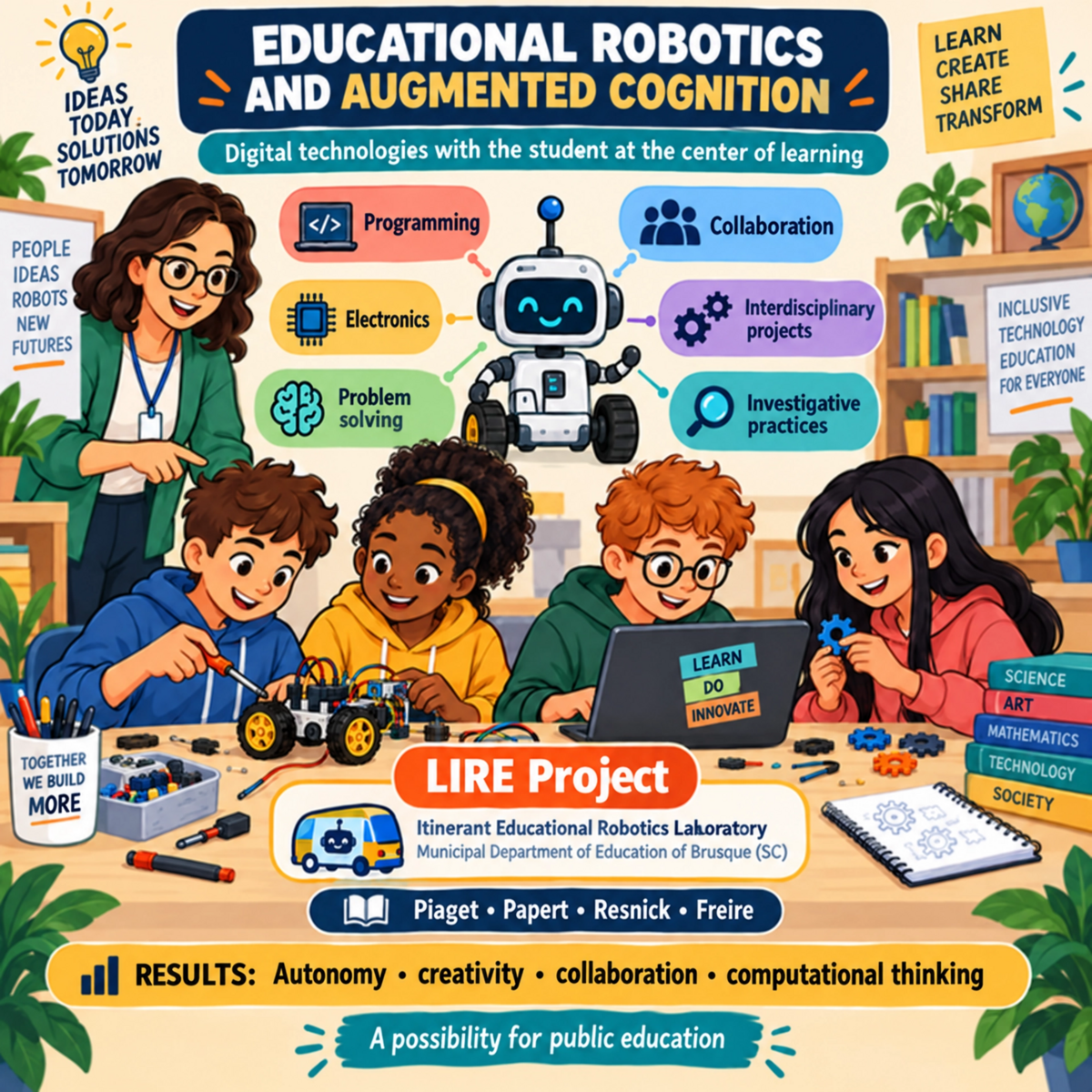
The growing presence of digital technologies in education expands the construction of knowledge, especially when combined with practices that place the student at the center of learning. In this context, educational robotics proves to be a promising strategy in which programming, electronics, problem-solving, and collaboration converge into meaningful experiences. This article reports on and reflects on the experience developed in the Robotics Clubs of the LIRE Project (Itinerant Educational Robotics Laboratory), an initiative of the Municipal Department of Education of Brusque (SC), which the author followed as a teacher educator. The reflection is organized around augmented cognition, understood as the expansion of cognitive possibilities arising from the interaction among students, digital technologies, and pedagogical mediation. Recurring situations observed in the workshops are discussed, along with their connection to Piaget, Papert, Resnick, and Freire. The experience suggests that educational robotics, integrated into interdisciplinary projects and inquiry-based practices, fosters autonomy, creativity, collaboration, and computational thinking, constituting a possibility for public education.
Downloads
References
BRASIL. Conselho Nacional de Educação. Câmara de Educação Básica. Resolução CNE/CEB nº 1, de 4 de outubro de 2022. Define normas sobre Computação na Educação Básica – Complemento à Base Nacional Comum Curricular (BNCC). Diário Oficial da União: seção 1, Brasília, DF, 6 out. 2022. Disponível em: https://portal.mec.gov.br/docman/outubro-2022-pdf/241671-rceb001-22/file. Acesso em: 23 out. 2026.
BRASIL. Ministério da Educação. Base Nacional Comum Curricular. Brasília, DF: Ministério da Educação, 2017. Disponível em: http://basenacionalcomum.mec.gov.br/. Acesso em: 23 out. 2026.
BRASIL. Presidência da República. Lei nº 14.533, de 11 de janeiro de 2023. Institui a Política Nacional de Educação Digital e altera as Leis nº 9.394, de 20 de dezembro de 1996, e nº 9.448, de 14 de março de 1997. Brasília, DF: Presidência da República, 2023. Disponível em: https://www.planalto.gov.br/ccivil_03/_ato2023-2026/2023/lei/l14533.htm. Acesso em: 23 out. 2026.
DALTRO, Mônica Ramos; FARIA, Anna Amélia de. Relato de experiência: uma narrativa científica na pós-modernidade. Estudos e Pesquisas em Psicologia, Rio de Janeiro, v. 19, n. 1, p. 223–237, 2019. DOI: 10.12957/epp.2019.43015. Disponível em: https://www.e-publicacoes.uerj.br/revispsi/article/view/43015. Acesso em: 30 out. 2026. DOI: https://doi.org/10.12957/epp.2019.43015
FREIRE, Paulo. Pedagogia da autonomia: saberes necessários à prática educativa. São Paulo: Paz e Terra, 1996.
LÜDKE, Menga; ANDRÉ, Marli Eliza Dalmazo Afonso de. Pesquisa em educação: abordagens qualitativas. 2. ed. Rio de Janeiro: EPU, 2013.
MINAYO, Maria Cecília de Souza. O desafio do conhecimento: pesquisa qualitativa em saúde. 14. ed. São Paulo: Hucitec, 2014.
MUSSI, Ricardo Franklin de Freitas; FLORES, Fábio Fernandes; ALMEIDA, Claudio Bispo de. Pressupostos para a elaboração de relato de experiência como conhecimento científico. Práxis Educacional, Vitória da Conquista, v. 17, n. 48, p. 60–77, 2021. DOI: 10.22481/praxisedu.v17i48.9010. Disponível em: https://periodicos2.uesb.br/index.php/praxis/article/view/9010. Acesso em: 30 out. 2026. DOI: https://doi.org/10.22481/praxisedu.v17i48.9010
PAPERT, Seymour. Mindstorms: children, computers, and powerful ideas. New York: Basic Books, 1980.
PIAGET, Jean. A equilibração das estruturas cognitivas: problema central do desenvolvimento. Rio de Janeiro: Zahar, 1975.
RESNICK, Mitchel. Jardim de infância para a vida toda: por uma aprendizagem criativa, mão na massa e relevante para todos. Porto Alegre: Penso, 2017.
SCHÖN, Donald A. Educando o profissional reflexivo: um novo design para o ensino e a aprendizagem. Porto Alegre: Artmed, 2000.
SILVA, Fabiana Coronel da; MAYER, Franciele Márcia; GROH, Ivanete Lago; VICENTINI, Taiani. Projeto LIRE: integrando educação, tecnologia e sustentabilidade na rede municipal de educação de Brusque. In: CONGRESSO DE INOVAÇÃO, TECNOLOGIA E SUSTENTABILIDADE (ITS), 7., 2025, Brusque. Anais [...]. Brusque, SC: UNIFEBE, 2025. p. 217-221. ISSN 2178-1605. DOI: 10.29327/1772558. Disponível em: https://www.unifebe.edu.br/site/wp-content/uploads/its-2025-2-1.pdf. Acesso em: 30 out. 2026. DOI: https://doi.org/10.29327/1772558.7-20
SILVA, Fabiana Coronel da; VICENTINI, Taiani; MAYER, Franciele Márcia. Formação docente na rede municipal de educação de Brusque: metodologias ativas e o uso do ambiente virtual de aprendizagem. In: FÓRUM INTERNACIONAL DE INOVAÇÃO E CRIATIVIDADE (INCREA), 13.; CONGRESSO INTERNACIONAL DE EDUCAÇÃO E SAÚDE (CIEDUS), 5.; CONGRESSO INTERNACIONAL DE EDUCAÇÃO (EDUQUE), 1., 2025, Brusque. Anais [...]. Brusque, SC: UNIFEBE, 2025. ISBN 978-65-272-1622-3. Disponível em: https://static.even3.com/anais/1098069.pdf?v=638968038996031004. Acesso em: 23 out. 2026.
VICENTINI, Taiani; MAYER, Franciele Márcia; SILVA, F. C. da; GROH, I. L. Educational robotics and block-based programming: teacher education in Brusque/SC. In: BRAZILIAN SYMPOSIUM ON ROBOTICS (SBR); WORKSHOP ON ROBOTICS IN EDUCATION (WRE), 2025, Vitória. Anais [...]. [S. l.]: IEEE, 2025. p. 361-366. Disponível em: https://sol.sbc.org.br/index.php/sbrlars/article/view/39261. Acesso em: 23 out. 2026. DOI: https://doi.org/10.1109/SBR/WRE66973.2025.11249522
VICENTINI, Taiani; SILVA, Fabiana Coronel da; MAYER, Franciele Márcia. Robótica e educação ambiental climática: a trajetória do LIRE e o uso de estações meteorológicas na rede municipal de educação de Brusque. In: FÓRUM INTERNACIONAL DE INOVAÇÃO E CRIATIVIDADE (INCREA), 13.; CONGRESSO INTERNACIONAL DE EDUCAÇÃO E SAÚDE (CIEDUS), 5.; CONGRESSO INTERNACIONAL DE EDUCAÇÃO (EDUQUE), 1., 2025, Brusque. Anais [...]. Brusque, SC: UNIFEBE, 2025. ISBN 978-65-272-1622-3. Disponível em: https://www.even3.com.br/anais/increa-ciedus-eduque-532630/1096749-robotica-e-educacao-ambiental-climatica--a-trajetoria-do-lire-e-o-uso-de-estacoes-meteorologicas-na-rede-municip/. Acesso em: 23 out. 2026.
Downloads
Published
Issue
Section
License
Copyright (c) 2026 Revista Hipótese

This work is licensed under a Creative Commons Attribution 4.0 International License.