Linguistic quantifiers and numerosity in autism
behavioral evidence regarding declarative memory compensation
DOI:
https://doi.org/10.58980/eiaerh.v12i00.459Keywords:
Autism Spectrum Disorder, Numerosity, Quantifiers, Declarative memory, PsycholinguisticsAbstract
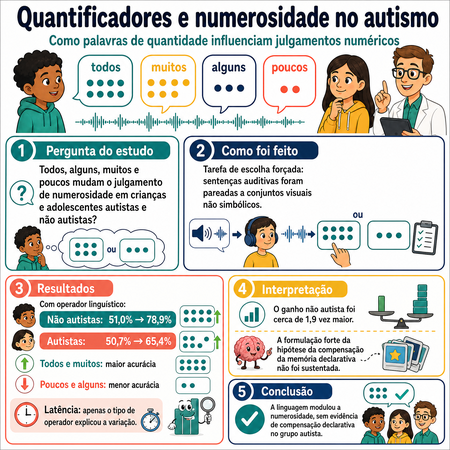
This study examined the extent to which the quantifiers todos (all), alguns (some), muitos (many), and poucos (few) modulated numerosity judgments in autistic and non-autistic children and adolescents and assessed their compatibility with the declarative memory compensation hypothesis. The study is motivated by the scarcity of research integrating linguistic quantification, numerical cognition in autism, and declarative/procedural memory. In a forced-choice task, auditory sentences were paired with nonsymbolic visual sets. Quantifier presence increased accuracy from 51.0% to 78.9% in the non-autistic group and from 50.7% to 65.4% in the autistic group. Only quantifier type accounted for variation in latency. Todos and muitos yielded higher accuracy, whereas poucos and alguns yielded lower accuracy. The gain was about 1.9 times greater in the non-autistic group, providing no support for the strong compensation hypothesis. The findings indicate linguistic modulation of numerosity judgments, without evidence of declarative compensation in the autistic group.
Downloads
References
AMERICAN PSYCHIATRIC ASSOCIATION. Manual diagnóstico e estatístico de transtornos mentais: DSM-5-TR. 5. ed. Porto Alegre: Artmed, 2022.
ANOBILE, G.; CICCHINI, G. M.; BURR, D. C. Separate mechanisms for perception of numerosity and density. Psychological Science, v. 25, n. 1, p. 265-270, 2014. DOI: 10.1177/0956797613501520. DOI: https://doi.org/10.1177/0956797613501520
BEFI-LOPES, D. M.; RODRIGUES, A.; PUGLISI, M. L. Aquisição do morfema de número em crianças em desenvolvimento normal de linguagem. Pró-Fono Revista de Atualização Científica, v. 21, n. 2, p. 171-174, 2009. DOI: 10.1590/S0104-56872009000200015. DOI: https://doi.org/10.1590/S0104-56872009000200015
BEZERRA, R. F. Memória declarativa e linguagem em crianças Asperger: um estudo do processamento de palavras morfologicamente derivadas em -eiro/-eira no português brasileiro. 2018. Dissertação (Mestrado) – Universidade Federal da Paraíba, João Pessoa, 2018.
BOUCHER, J.; ANNS, S. Memory, learning and language in autism spectrum disorder. Autism & Developmental Language Impairments, v. 3, p. 1-13, 2018. DOI: 10.1177/2396941517742078. DOI: https://doi.org/10.1177/2396941517742078
CAREY, S. Where our number concepts come from. The Journal of Philosophy, v. 106, n. 4, p. 220-254, 2009. DOI: 10.5840/jphil2009106418. DOI: https://doi.org/10.5840/jphil2009106418
CASTILHO, C. M. Quantificadores indefinidos. In: ILARI, R. (org.). Gramática do português culto falado do Brasil: palavras de classe fechada. São Paulo: Contexto, 2015. v. 4, p. 147-162.
CHIERCHIA, G. Semântica. Campinas: Editora da Unicamp; Londrina: Eduel, 2003.
DESCHAMPS, I.; AGMON, G.; LOEWENSTEIN, Y.; GRODZINSKY, Y. The processing of polar quantifiers, and numerosity perception. Cognition, v. 143, p. 115-128, 2015. DOI: 10.1016/j.cognition.2015.06.006. DOI: https://doi.org/10.1016/j.cognition.2015.06.006
FEIGENSON, L.; DEHAENE, S.; SPELKE, E. Core systems of number. Trends in Cognitive Sciences, v. 8, n. 7, p. 307-314, 2004. DOI: 10.1016/j.tics.2004.05.002. DOI: https://doi.org/10.1016/j.tics.2004.05.002
HALBERDA, J.; FEIGENSON, L. Developmental change in the acuity of the “number sense”: the approximate number system in 3-, 4-, 5-, and 6-year-olds and adults. Developmental Psychology, v. 44, n. 5, p. 1457-1465, 2008. DOI: 10.1037/a0012682. DOI: https://doi.org/10.1037/a0012682
KATSOS, N.; BISHOP, D. V. M. Pragmatic tolerance: implications for the acquisition of informativeness and implicature. Cognition, v. 120, n. 1, p. 67-81, 2011. DOI: 10.1016/j.cognition.2011.02.015. DOI: https://doi.org/10.1016/j.cognition.2011.02.015
KJELGAARD, M. M.; TAGER-FLUSBERG, H. An investigation of language impairment in autism: implications for genetic subgroups. Language and Cognitive Processes, v. 16, n. 2-3, p. 287-308, 2001. DOI: 10.1080/01690960042000058. DOI: https://doi.org/10.1080/01690960042000058
MARCILESE, M. Aquisição da linguagem e habilidades cognitivas superiores: o papel da língua no desenvolvimento da cognição numérica. Alfa: Revista de Linguística, v. 56, n. 2, p. 557-581, 2012. DOI: 10.1590/S1981-57942012000200009. DOI: https://doi.org/10.1590/S1981-57942012000200009
MEAUX, E.; TAYLOR, M. J.; PANG, E. W.; VARA, A. S.; BATTY, M. Neural substrates of numerosity estimation in autism. Human Brain Mapping, v. 35, n. 9, p. 4362-4385, 2014. DOI: 10.1002/hbm.22480. DOI: https://doi.org/10.1002/hbm.22480
RAMOTOWSKA, S.; HAAF, J.; VAN MAANEN, L.; SZYMANIK, J. Most quantifiers have many meanings. Psychonomic Bulletin & Review, v. 31, n. 6, p. 2692-2703, 2024. DOI: 10.3758/s13423-024-02502-7. DOI: https://doi.org/10.3758/s13423-024-02502-7
RATCLIFF, R.; VOSKUILEN, C.; TEODORESCU, A. Modeling 2-alternative forced-choice tasks: accounting for both magnitude and difference effects. Cognitive Psychology, v. 103, p. 1–22, 2018. DOI: 10.1016/j.cogpsych.2018.02.002. DOI: https://doi.org/10.1016/j.cogpsych.2018.02.002
SZYMANIK, J.; ZAJENKOWSKI, M. Monotonicity has only a relative effect on the complexity of quantifier verification. In: ALONI, M.; FRANKE, M.; ROELOFSEN, F. (ed.). Proceedings of the 19th Amsterdam Colloquium. Amsterdam: University of Amsterdam, ILLC, 2013. p. 219–225. DOI: https://doi.org/10.53437/xrd16j41
ULLMAN, M. T. Contributions of memory circuits to language: the declarative/procedural model. Cognition, v. 92, n. 1-2, p. 231-270, 2004. DOI: 10.1016/j.cognition.2003.10.008. DOI: https://doi.org/10.1016/j.cognition.2003.10.008
ULLMAN, M. T.; PULLMAN, M. Y. A compensatory role for declarative memory in neurodevelopmental disorders. Neuroscience & Biobehavioral Reviews, v. 51, p. 205-222, 2015. DOI: 10.1016/j.neubiorev.2015.01.008. DOI: https://doi.org/10.1016/j.neubiorev.2015.01.008
Downloads
Published
Issue
Section
License
Copyright (c) 2026 Revista Hipótese

This work is licensed under a Creative Commons Attribution 4.0 International License.